
Why Paid Search Management Matters for Your Business
Paid search management is the process of planning, running, and optimizing pay-per-click (PPC) advertising campaigns on search engines like Google and Bing. It helps your business show up at the top of search results when potential customers are actively looking for what you offer.
Here’s what paid search management includes:
- Keyword research to find the terms your customers are searching for
- Ad creation that speaks directly to customer needs
- Bidding strategies to control costs and maximize visibility
- Performance tracking to measure what’s working and what’s not
- Ongoing optimization to improve results over time
The goal is simple: connect with people who are already looking for your product or service, right when they need it.
Most business owners face a familiar problem: getting in front of the right people at the right time. Organic search takes months, word of mouth only goes so far, and traditional advertising can feel like a gamble.
Paid search is different.
When someone in Winston-Salem searches for “plumber near me” or “best accounting firm in Greensboro,” they have a problem they want solved now. If your ad shows up at the top of that search, you’re not interrupting them. You’re answering their question.
That’s the power of paid search: putting your business directly in front of people who are already looking.
And unlike other forms of marketing, paid search is measurable. You know exactly how much you’re spending, how many people clicked, and how many became customers. Businesses make an average of $2 for every $1 they spend with Google Ads, making it one of the most cost-effective ways to grow.
But running effective campaigns isn’t automatic. It requires strategy, testing, and ongoing attention. That’s where paid search management comes in.
What is Paid Search and How is it Different?
Paid search is when you pay to have your business show up at the top of search results. Instead of waiting months to climb the rankings organically, you’re essentially buying a spot where people are already looking.
Think of it like this: organic search results are like earning your way to the front of the line. Paid search is like reserving a spot at the front when you need to be there now.
Most paid search uses a pay per click (PPC) model. You only pay when someone clicks your ad and lands on your website, not just for seeing it.
This makes paid search different from traditional advertising. You’re not paying for a billboard that thousands of people might ignore. You’re paying for people who were interested enough to click.
Search Engine Marketing (SEM) is another term you’ll hear. It once included both paid and organic search, but today SEM usually just means paid search advertising.
Here’s how paid search compares to SEO:
| Feature | Paid Search | SEO |
|---|---|---|
| Speed to Results | Immediate | Weeks or months |
| Cost Model | pay per click (PPC) | Investment in content, optimization |
| Visibility | Top of SERP, marked “Ad” | Natural listings, below ads |
| Control | High (budget, targeting, ads) | Moderate (algorithm dependent) |
| Longevity | Continues as long as you pay | Long lasting once ranked |
| Targeting | Precise (keywords, demographics) | Broader (topic relevance) |
For more on how these two strategies can work together, check out our insights on combining SEO and PPC.
Paid Search vs. SEO: Choosing Your Path
When you’re trying to get found online, you have two main paths: paid search and SEO. They both get you in front of customers, but in very different ways.
Paid search gives you immediate visibility. Launch a campaign today, and your ads can be live within hours. This is perfect when you need traffic right now, like for a weekend sale, a new service launch, or when you’re just starting out and have no organic presence yet.
SEO is about long-term growth. It means improving your website so search engines naturally rank you higher over time. It takes patience and consistent effort. But once you’ve earned those top organic spots, that traffic doesn’t cost you per click.
Budget plays a role too. Paid search requires ongoing ad spend. Stop paying, and your visibility disappears. SEO requires an upfront investment in content and optimization, but the results compound over time.
For most businesses in the Triad, a combined strategy works best. Use paid search for leads today while SEO builds your foundation for tomorrow. It’s like buying groceries for tonight while also planting a garden for the future.
Paid Search vs. PPC: Understanding the Terms
These terms get used interchangeably, but they’re not quite the same thing.
PPC is a pricing model. It means you pay each time someone clicks your ad. That’s it. It’s a way of buying traffic, not a specific place where ads appear.
Paid search is a specific channel. It’s advertising on search engine results pages like Google or Bing. So while all paid search campaigns use PPC pricing, not all PPC campaigns are paid search.
Here’s where it gets clearer: when you run an ad on Facebook and pay per click, that’s PPC. When you run a display ad on a news website and pay per click, that’s also PPC. But neither of those is paid search because they’re not on a search engine results page.
Paid search management specifically focuses on running and optimizing campaigns on search engines where people are actively looking for what you offer. Social media ads and display ads reach people who might be interested. Paid search reaches people who are already searching.
That difference matters. Someone searching “emergency plumber Winston-Salem” at 10 PM has very different intent than someone scrolling Facebook who happens to see a plumbing ad.
Why Paid Search Matters for Your Business

There’s something powerful about paid search management that other forms of marketing just don’t offer. It puts you in front of people who are already looking for what you sell.
When someone in Winston-Salem types “emergency plumber” or “accounting services near me” into Google, they’re not casually browsing. They have a problem. They need help now. And they’re actively searching for a solution.
That’s where paid search makes all the difference. You’re not interrupting someone’s day with an ad they didn’t ask for. You’re showing up exactly when they need you most. It’s like having a storefront on the busiest street in town, right when foot traffic is at its peak.
The measurable results are what really set paid search apart. You know exactly how much you’re spending, who’s clicking, and what they do on your site.
You also get complete control over your budget. Spend $10 a day or $1,000. Test what works. Scale up when you see results. Pause when you need to. There’s no long term contract locking you in.
And unlike traditional advertising, paid search is scalable. If a campaign is bringing in customers at a profit, you can invest more and get more. If something’s not working, you can adjust it within hours, not months.
For local businesses in the Triad region, paid search offers something especially valuable: local targeting. You can show your ads only to people searching within a specific radius of your business. A bakery in downtown Winston-Salem can target people searching for “fresh bread near me” within five miles. You’re not wasting money on people who’ll never walk through your door.
The Benefit of Immediate Results
Here’s the thing about SEO. It’s valuable, but it takes time. You usually have to wait around 2-4 or even 6 months before you see your website climb the rankings.
Paid search works differently. Your ad can appear on page one within hours of launching your campaign. Sometimes minutes.
That speed matters when you need results now. Maybe you’re running a weekend sale. Maybe you just launched a new service. Maybe you have open appointment slots this week that you need to fill. Paid search lets you drive traffic for a sale or event right when you need it most.
It’s also faster than SEO for testing. Want to know if people respond better to “affordable” or “premium” in your messaging? Run two ads and you’ll have an answer by tomorrow. That kind of rapid feedback helps you understand your customers better and refine your entire marketing approach.
Connecting with High-Intent Customers
Not all website visitors are created equal. Someone who stumbles across your site while browsing is very different from someone who searched for exactly what you offer.
That second person? They’re a high intent customer. They’re actively looking for a solution. They’re comparing options. They’re often ready to buy.
When you target these active searchers, you’re not just getting traffic. You’re getting qualified traffic. People who actually need what you’re selling.
The numbers back this up. Paid visitors are 2 times more likely to make a purchase compared to organic visitors. That’s because keyword intent matters. Someone searching “buy running shoes size 10” is much closer to a purchase than someone searching “how to start running.”
Understanding that intent lets you craft ads that speak directly to where someone is in their decision process. You’re not just throwing ads at everyone and hoping something sticks. You’re solving a customer’s problem at the exact moment they’re looking for help.
And that’s what makes paid search so effective. It’s about timing, relevance, and meeting people where they are. For businesses here in the Triad and beyond, that kind of precision is what turns clicks into customers.
A Practical Guide to Paid Search Management
Running a paid search campaign isn’t something you set up once and forget about. It’s an ongoing conversation between your ads, your audience, and the search engines.
The best paid search management comes from understanding that every piece matters. The keywords you choose. The ads you write. How much you bid. Where you send people when they click. How you measure what’s working.
It’s not complicated, but it does require attention. Let’s walk through what actually matters when you’re trying to get results from paid search.
Setting Up Your First Campaign
Starting your first campaign is simpler than most people think. You just need to make a few good decisions upfront.
First, pick your platform. Google Ads is where most businesses start because that’s where most searches happen. Microsoft Ads is also worth considering, especially if your customers tend to use Bing. For now, we’ll focus on Google since it’s the most common starting point.
Before you write a single ad, get clear on what you want to happen. Are you trying to get phone calls? Form submissions? Online purchases? Your goal shapes everything else.
Then decide what you can spend. You set a daily budget, and Google won’t spend more than that. If you want to spend $50 a day, that’s what you’ll spend. You have control.
Now comes keyword research. This is where you figure out what people are actually typing into Google when they’re looking for businesses like yours. Google Keyword Planner is free and shows you what people in your area are searching for. If you’re a roofer in Greensboro, you’ll want to know if people search for “roof repair Greensboro” or “emergency roofer near me” more often.
When you add keywords, you’ll choose match types. Exact match shows your ad only for that specific phrase. Phrase match includes that phrase but allows extra words before or after. Broad match casts a wider net and includes related searches. Most campaigns start with a mix of all three.
Writing your ad comes last, but it’s critical. Your ad needs to connect with what someone just searched for. Include your keyword in the headline. Tell people what makes you different. Give them a clear reason to click. Use ad extensions to add your phone number, location, or links to specific pages on your site.
Understanding How Your Ads Are Ranked
You might think the business willing to pay the most gets the top spot. That’s not quite how it works.
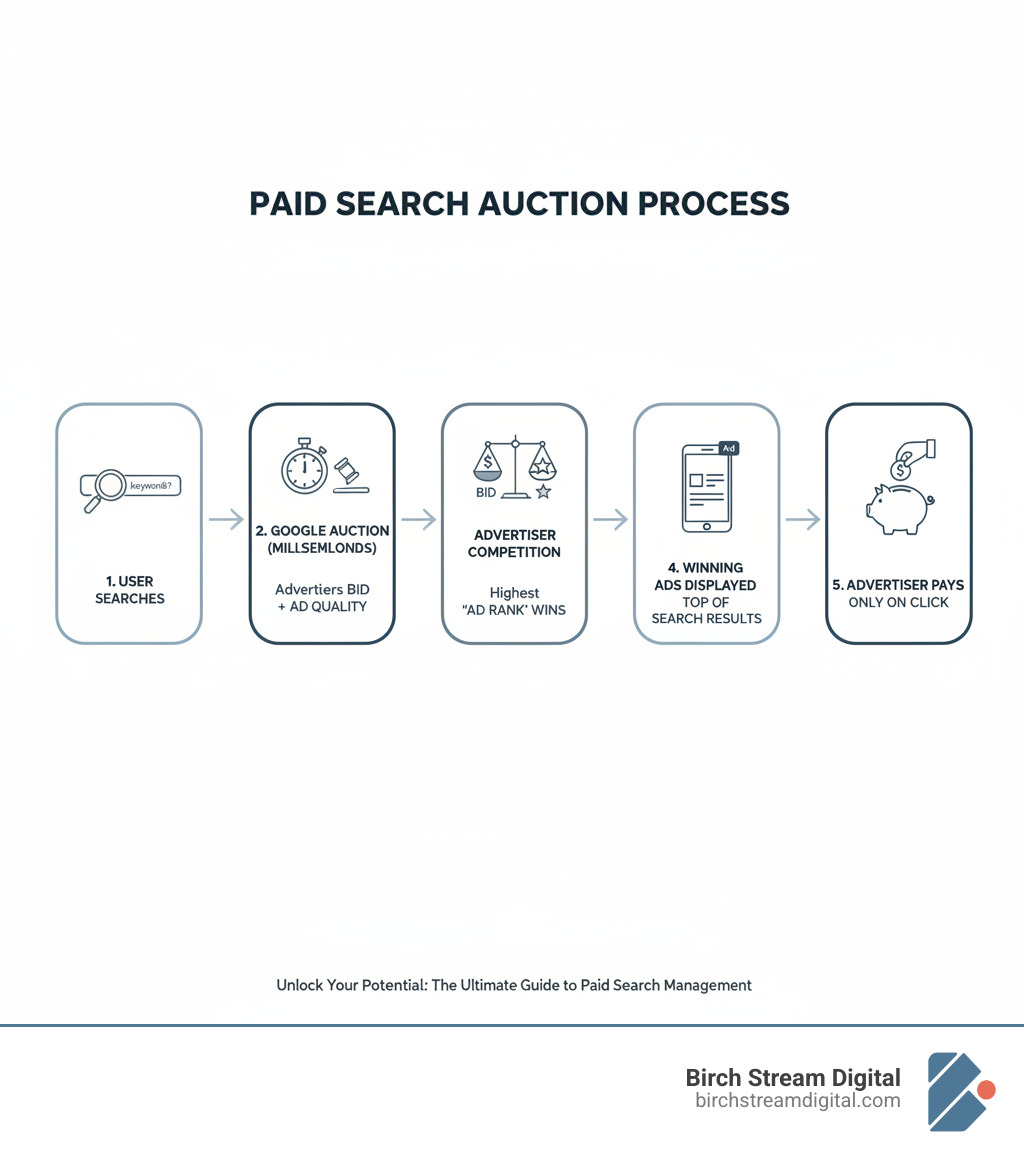
Google runs an auction every time someone searches. This happens in milliseconds. Your ad’s position depends on something called Ad Rank, which looks at two main things: how much you’re willing to pay and how good your ad is.
Your maximum bid is the most you’ll pay for a click. But here’s the thing: you usually pay less than your maximum. You only need to pay enough to beat the person below you.
Then there’s your Quality Score. This is a grade from 1 to 10 that measures whether your ad and landing page are actually helpful to the person searching. Google looks at three things: how often people click your ad when they see it, whether your ad matches what they searched for, and whether your landing page gives them what they’re looking for.
A high Quality Score means you can show up higher while paying less per click. Google rewards ads that help people, not just the ones with the biggest budget. If you want to dig deeper into improving this, Google’s guide on how to improve your Quality Score is worth reading.
Optimizing for Real Results and ROI
Once your campaign is running, you’re not done. You’re just getting started.
Good paid search management means watching what’s happening and making it better. You track a handful of numbers that tell you if things are working.
Click through rate (CTR) shows what percentage of people who see your ad actually click it. If this number is low, your ad copy probably isn’t connecting with what people searched for.
Cost per click (CPC) is what you actually pay each time someone clicks. Lower is better because it means your budget goes further.
Conversion rate is the big one. It shows how many clicks turn into actual customers. You can get a thousand clicks, but if nobody calls or fills out your form, those clicks didn’t help.
Cost per acquisition (CPA) tells you how much you spend to get one customer. If you spend $200 in ads and get four customers, your CPA is $50.
Return on ad spend (ROAS) shows how much money you make for every dollar you spend. This is what actually matters to your bottom line.
Testing is constant. You run two versions of an ad to see which headline works better. You try different calls to action. You test whether mentioning your city in the ad makes more people click.
Your landing page matters just as much as your ad. If someone clicks an ad about roof repair and lands on your homepage, they’ll probably leave. Send them to a page that talks specifically about roof repair, with a clear way to contact you.
One more thing saves a lot of wasted money: negative keywords. These are words you tell Google to ignore. If you sell new furniture, you add “used” and “secondhand” as negative keywords. This keeps your ads from showing to people looking for something you don’t offer.
For more ways to get better results from your ad spend, take a look at our Paid Advertising services. Read our Winston-Salem Google reviews to see real results from local businesses.
Building the Right Team for Your Paid Search
Running effective paid search management isn’t usually a one-person job. Even if you’re a small business, you need the right mix of skills to make your campaigns work.

The good news? Your team doesn’t have to look like everyone else’s. A startup in Winston-Salem might have one person handling everything. A mid-sized company might have three or four specialists. The structure depends on your budget, your goals, and how much you’re spending on ads.
What matters most is having the right expertise in place, whether that’s in house or through a partner.
Key Roles and Responsibilities
Most successful paid search teams cover four main areas of work.
Someone needs to handle strategy and planning. This person thinks about the big picture. They figure out which audiences to target, what goals make sense, and how paid search fits into your overall marketing. They’re not in the weeds every day, but they set the direction.
Then there’s daily campaign management. This is where the actual work happens. Someone builds campaigns, writes ads, adjusts bids, and keeps an eye on budgets. They make sure everything runs smoothly and catch problems before they get expensive.
Data analysis and reporting is the third piece. You need someone who can look at performance data and tell you what it means. Are your ads working? Which keywords are worth the money? What should you change? This role turns numbers into decisions.
Finally, there’s creative and copywriting. Your ads need to stand out and speak to real people. Someone has to write headlines that grab attention and descriptions that make people want to click. This part is easy to overlook, but bad ad copy wastes money fast.
In a small business, one person might wear all these hats. As you grow, you can split these responsibilities across a team. A local restaurant might start with a generalist who does everything. A regional service company might hire a campaign manager, then add a data analyst as their ad spend grows.
When to Hire an Agency or Freelancer
A lot of businesses in the Triad region choose to work with an agency or freelancer for their paid search management. It’s not because they can’t do it themselves. It’s because paid search takes time and specialized knowledge that’s hard to build in house.
If you don’t have someone on staff who really knows Google Ads, you’re starting from scratch. The platforms are complicated. They change constantly. What worked six months ago might not work now. An agency or freelancer already knows the current best practices and has managed campaigns across different industries.
Maybe you need to move fast. If you’re launching a new service or opening a second location, you don’t have months to train someone. An experienced partner can get campaigns running in days, not weeks.
There’s also the tool factor. Good paid search work often requires software for tracking, reporting, and optimization. These tools can cost hundreds of dollars a month. Agencies already have them.
For many businesses, it’s simply more cost effective. You get expert level work without paying for a full time salary, benefits, and training. You can focus on running your business while someone else handles the details of your campaigns.
That’s where working with a PPC Management Firm makes sense. You get a team that knows what they’re doing, without the overhead of building one yourself.
Frequently Asked Questions about Paid Search Management
We talk with business owners every day about paid search management. These are the questions that come up most often.
How much should I budget for paid search?
There’s no magic number here. Your budget really depends on what you’re trying to accomplish and what industry you’re in.
The good news is you can start small. Some businesses begin with just $10 or $20 a day to test things out. There’s no requirement to spend thousands right away.
A practical approach is to think about what a new customer is worth to your business. If someone becomes a customer and typically spends $100, and you’re comfortable spending $20 to get that customer, you can build your budget around that math.
Industry benchmarks can help you get a sense of what’s typical. The average conversion rate for search ads is around 3.75%, but this varies quite a bit. A law firm might see different results than a home goods store.
We usually recommend starting with a modest budget, seeing what happens, and then increasing your spending on what’s working. This way you’re not guessing with your money. You’re learning what actually brings customers through the door.
How long does it take to see results from paid search?
This is one of the best parts of paid search. You can see your ads live within hours of launching a campaign. Unlike SEO, which takes months to build momentum, paid search puts you at the top of the page almost immediately.
You’ll start getting clicks and traffic right away. The first few days show you if people are interested in your offer.
That said, you need a bit of time to collect enough data to make smart decisions. We usually see meaningful patterns emerge within a week or two. This tells us what’s working and what needs adjusting.
Full optimization is ongoing. You’re always learning and improving. But if you need people visiting your website today for a time-sensitive promotion or event, paid search can deliver that kind of speed. No other marketing channel moves this fast.
What is a good Quality Score?
Google assigns each of your keywords a Quality Score between 1 and 10. It’s their way of measuring how relevant and helpful your ad and landing page are to the person searching.
We generally aim for a score of 7 or higher. A good Quality Score matters because it directly affects two important things: where your ad appears and how much you pay per click. Better scores mean better positions and lower costs.
The factors that determine your Quality Score are mostly in your control. Ad relevance matters. Your ad should match what someone is searching for. Landing page experience is important too. When someone clicks your ad, the page they land on should be useful, relevant, and quick to load.
Improving these areas naturally lifts your Quality Score. This makes your paid search management more efficient and helps your budget go further. It’s one of those areas where doing better work actually costs you less money.
Getting Started with Paid Search
Paid search is one of the most powerful tools you have for growing your business. It gives you real control over who sees your message and when. More importantly, it provides clear, measurable data that shows exactly how your marketing dollars are working.
For businesses in the Triad region and beyond, paid search management opens doors that might otherwise take months or years to open up through other channels. You can connect with customers right when they’re looking for what you offer.
Now, you absolutely can manage paid search yourself. Many business owners do, especially when they’re just starting out. The platforms are designed to be accessible, and there’s plenty of learning resources available.
But here’s what we’ve seen: paid search gets complicated fast. The difference between a campaign that breaks even and one that actually drives growth often comes down to nuances. Things like bidding strategies, ad testing rhythms, and how you interpret performance data.
That’s where partnering with a team that understands these details can make a real difference. At Birch Stream Digital, we help businesses steer digital marketing with clarity. We’re not interested in jargon or complexity for its own sake. We want to help you understand what’s working and why.
If you’re curious about how paid search and SEO can work together for your business, we’d be happy to talk through it. Every business is different, and the right strategy depends on your specific goals, budget, and timeline. We can help you build an approach that actually makes sense for where you are right now.