
Your Website Should Be Your Hardest-Working Employee
Data driven web design is the practice of using real user behavior and measurable insights, not guesswork, to make decisions about your website’s layout, content, and functionality. Here’s what it means for your business:
- Removes guesswork – Design choices are based on what users actually do, not what you assume they want
- Increases conversions – Strategic changes guide visitors toward taking action (calls, form fills, purchases)
- Continuous improvement – Your site evolves based on real performance data, not opinions
- Measurable results – You can track what’s working and what’s not, making smarter investments
Many businesses invest in a professional website but find it doesn’t generate the expected calls, form fills, or sales. This can happen when a digital storefront isn’t effectively engaging customers.
For example, a local Winston-Salem retailer might launch a beautiful site, but if the “Shop Now” button is hard to find or the mobile experience is clunky, customers will leave without buying.
This happens when design decisions are based on guesswork instead of real user behavior.
Data driven web design addresses this by using facts, not feelings, to build a website that supports your business goals. Instead of wondering why visitors leave without converting, you can find clear answers and identify a path forward.
I’m Hooman Bahrani, founder of Birch Stream Digital, and I’ve spent years building websites, running a SaaS company, and studying user behavior across industries. I use data driven web design to help Triad businesses align their websites with their growth objectives.
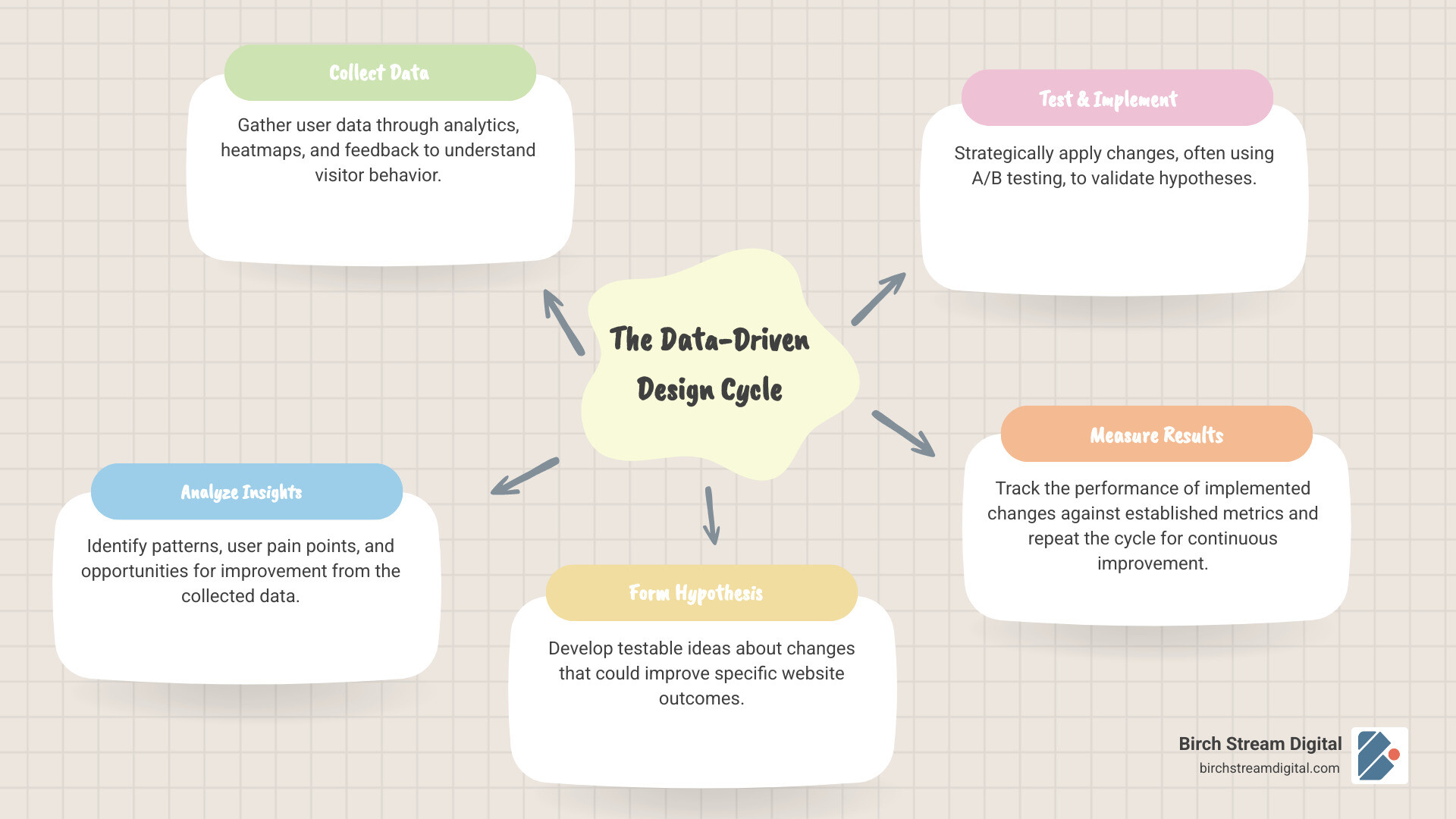
Is Your Website Working for You?
This guide is for business owners and marketing managers in the Triad who are looking for a more strategic approach to their online presence. It is for those who want to move beyond guesswork to better understand what their customers want.
Common Symptoms of a Guesswork-Driven Website
If you recognize any of these in your business, a data-driven approach could be what you need:
- Your bounce rate is high, and visitors leave quickly.
- You get website traffic but few leads or sales.
- Customers say they can’t find what they need on your site.
- You don’t know which marketing efforts are actually driving results.
- You made design choices based on what you like, not what your users need.
How This Solves Your Problem
This article will walk you through a process for using data to understand your visitors and make informed improvements. You’ll learn how to build a website that guides customers to action and supports your business goals.
Why We Often Guess Instead of Know
It’s natural to make assumptions about what our customers want. We’re all human, and it’s easy to fall into a trap called the “false-consensus effect.” This is our tendency to assume that others share our beliefs and preferences. For example, you might love a certain color scheme or a navigation style, assuming your customers will too. But your customers might have different tastes, different needs, and different ways of interacting with your site.
This is where data is useful. It provides an objective lens, removing personal bias to focus on what serves the customer. By letting real user behavior guide our decisions, we can create a website that works for them, not just for us. This can lead to better results for your business.
We believe your website should be a strategic asset, not just a brochure. It should actively contribute to your business goals, and data can help make that happen.
What is Data-Driven Web Design?
At its core, data driven web design is the practice of using real user information, not just intuition, to make decisions about your website’s layout, content, and functionality. It’s a shift from a “set it and forget it” approach to a cycle of continuous improvement. This helps your site evolve with your customers’ needs, which can support trust and business growth. Have questions? Reach out and we can talk through what makes sense for your business.
Traditional Design vs. Data-Driven Web Design
To truly appreciate the power of a data-driven approach, let’s compare it to traditional web design:
| Feature | Traditional Web Design | Data-Driven Web Design |
|---|---|---|
| Basis of Decisions | Assumptions, intuition, personal preference | Empirical evidence, user behavior, analytics |
| Process | One-time project, static launch | Iterative cycle of continuous improvement |
| Success Metrics | Subjective (e.g., “looks good”) | Measurable KPIs (e.g., conversion rate, reduced bounce rate) |
| Changes | Difficult, often costly, guesswork | Strategic, informed, efficient, based on real data |
A traditional website can be compared to a billboard in the forest – it may be well-designed, but not necessarily seen or effective. A data-driven website, however, is designed to evolve and adapt, helping it meet your business objectives.
The Core Components of a Data-Driven Website
A data-driven website is not complicated. It simply means you have the tools you need to understand your visitors and make improvements without rebuilding everything. The most important pieces are:
- Analytics so you can see what people do
- A website can be regularly updated
- The ability to test changes and measure results
These components can work together to help your website gather insights and adapt over time. Learn more about our Web Design and Redesign services that incorporate these principles.
Why This Approach Matters for Your Business
Embracing data driven web design can be a strategic decision for businesses in Winston-Salem and across the Triad.
- Reduces Guesswork: Instead of making design decisions based on intuition, you can use evidence from user data. This approach helps confirm that your website is functioning as intended, providing users with what they need, which can lead to reduced bounce rates and improved user satisfaction.
- Focuses on User Experience (UX): By analyzing user data, you can gain insights into what your visitors are looking for and where they get stuck. This can lead to an improved user experience, which is important for engagement and conversions.
- Connects Website Changes to Business Goals: Data can help you identify bottlenecks in your conversion funnel and make data-backed improvements. This means that changes can be aimed at increasing leads, sales, or other key business objectives.
- Improves Return on Investment: When you make informed decisions, you can invest your resources more effectively. A data-driven approach can lead to growth in conversion rates and sales, helping your website budget generate returns.
- Helps You Understand Your Customer Journey: Data allows you to map parts of the customer journey, from a first visit to a purchase or inquiry. This understanding is useful for creating marketing campaigns and building customer relationships.
Gathering the Right Data for Your Website
To make informed decisions, you need the right information. Data isn’t just a bunch of complicated numbers; it’s the story of how real people interact with your business online. Understanding this story is the first step toward making your website more effective.
Quantitative Data: The “What”

Quantitative data is all about numbers and measurable facts. It tells us what users are doing on your website. This objective data helps us identify trends and patterns.
Examples of quantitative data we look at include:
- Website Traffic: How many visitors come to your site? Where do they come from?
- Bounce Rate: The percentage of visitors who leave your site after viewing only one page. A high bounce rate often signals issues with content, load speed, or navigation.
- Conversion Rates: The percentage of visitors who complete a desired action, like filling out a form, making a purchase, or downloading a resource.
- Time on Page: How long visitors spend on specific pages.
- Pages per Session: The average number of pages a user views during a single visit.
Tools like Google Analytics and Google Search Console are commonly used for collecting this type of data. They can provide a picture of user behavior and website performance.
Qualitative Data: The “Why”
While quantitative data tells us what is happening, qualitative data can help us understand why. This subjective data offers perspective and insights into user motivations, feelings, and challenges.
Examples of qualitative data include:
- User Surveys: Directly asking your audience about their experience, preferences, and pain points. User surveys are one way to collect this data.
- Feedback Forms: Simple forms on your site where users can submit comments or suggestions.
- User Interviews: One-on-one conversations that can provide detailed insights into individual user experiences.
- Heatmaps: Visual representations of where users click, move their mouse, or scroll on a page. This helps identify areas of interest or confusion.
- Session Recordings: Videos of actual user sessions, showing how they steer, where they get stuck, and their overall journey.
Combining both quantitative and qualitative data can provide a more complete view. For instance, quantitative data might show a high bounce rate on a service page, and qualitative data from a survey might reveal that users found the pricing unclear. This combination can lead to more informed decisions.
A Simple Checklist for Getting Started with Data-Driven Web Design
Ready to take the first step towards a smarter website? Here’s a simple checklist to get you started:
-
- Define a clear goal (e.g., “increase quote requests by 15%”).
-
- Identify one or two key metrics to track (e.g., form submission rate).
-
- Set up a free tool like Google Analytics to collect quantitative data.
-
- Add a simple feedback form to your site to gather qualitative insights.
-
- Review the data weekly to look for patterns.
Putting Data into Action: A Practical Guide
Collecting data is the first step. The next step is using those insights to make strategic changes that can improve your user experience and guide visitors toward your goals. This is how a data-driven approach can affect your business outcomes.
Using A/B Testing to Find What Works
A/B testing, also known as split testing, is a common technique in data driven web design. It involves creating two versions of a web page element (like a headline, image, or button) and showing each version to different segments of your audience. You can then measure which version performs better based on your defined goals.
For example, you might test a green “Request a Quote” button against a blue one to see which one gets more clicks. Or, you could test two different headlines on a landing page to see which leads to more form submissions. This isn’t about guesswork; it’s about making small, iterative improvements based on evidence. A/B testing statistics show its effectiveness in increasing conversion rates and sales.
Personalizing the Customer Journey
Personalization, driven by data, allows a website to adapt to a user’s needs. By understanding user behavior, you can segment your audience and tailor content to their specific interests.
For instance, if a visitor frequently browses your commercial plumbing services, you could show them different homepage banners or related content than a new visitor who just arrived from a general search for “plumbers in Greensboro.” This dynamic content delivery can improve relevance and engagement. It contributes to a professional website experience and helps guide them along their customer journey.
Optimizing for Conversions and Revenue
Data driven web design can help turn your website into an asset that generates revenue. You can use data to find and address issues that may be preventing visitors from converting into customers.
This means:
- Identifying Bottlenecks: Identifying where users drop off in your sales funnel (e.g., a specific step in a checkout process or a complex contact form).
- Simplifying Navigation: Helping users find what they need more easily. If data shows users are struggling to find information, you might reorganize menu categories or implement improved search functionality.
- Clarifying Calls-to-Action (CTAs): Making your “Contact Us,” “Buy Now,” or “Get a Quote” buttons clear and easy to find.
- Reducing Friction: Streamlining processes like filling out forms or completing a purchase.
By optimizing these elements based on user data, you can improve your conversion rates and contribute to your business’s growth. This data also helps connect your website performance to your broader SEO and PPC campaigns, helping your digital efforts work together.
Frequently Asked Questions about Data-Driven Design
What’s the difference between a data-driven and a static website?
A static website is like a printed brochure-it’s built once and rarely changes. It presents information but doesn’t learn or adapt. A data-driven website is dynamic; it uses analytics and user feedback to continuously evolve and improve its content, layout, and functionality to serve visitors. It’s an ongoing process of optimization based on real user behavior.
Do I need to be a data expert to do this?
Not at all. You can start with simple, free tools like Google Analytics to understand basic user behavior. The goal is to begin making small, informed decisions rather than trying to become a data scientist overnight. Many businesses partner with agencies like ours to help interpret the data and apply it effectively.
How does this help increase my business’s revenue?
By understanding what your users want and where they struggle, you can address issues that may prevent them from converting. This could mean simplifying your contact form, clarifying your service descriptions, or making your “Buy Now” button more prominent, all of which can lead to more leads and sales. Data-driven insights can help you make more informed investments in marketing tactics that can result in revenue growth.
Is data-driven design expensive?
It doesn’t have to be. The principle is about making informed decisions, which can save money by avoiding redesigns based on guesswork. The process is scalable, so you can start small and expand your efforts as you see a return. The initial investment in setting up tracking and analytics can be minimal, and the long-term gains can outweigh the costs.
How long does it take to see results?
You can sometimes see changes from small, data-informed tweaks within a few weeks. For example, clarifying a headline could lower a page’s bounce rate. Consistent, iterative improvement over time is a central part of the process. It’s not a one-time fix, but an ongoing process that can yield benefits.
Your Partner in Building a Smarter Website
Moving to a data-driven approach can feel complex, but it is about listening to your customers and responding to their needs. By taking small, steady steps, you can help your website become a more effective tool for business growth. It’s a practical way to help your investment generate returns.
We understand the challenges and opportunities for businesses in Winston-Salem, High Point, and across the Triad. Our approach to data driven web design is focused on helping local businesses by creating online experiences that connect with their audience.
Need help? Contact Birch Stream Digital and we can walk through your goals together.