

What is Paid Search Bid Management?
Paid search bid management is the process of setting and adjusting how much you’re willing to pay when someone clicks your ad on search engines like Google. It’s not just about spending more money. It’s about spending smarter to reach the right people at the right time, while staying within your budget.
Here’s what paid search bid management really means:
It’s the work of setting your maximum bids for important keywords, adjusting those bids as performance data comes in, choosing between manual control and automated strategies, and monitoring results with metrics like cost per conversion and overall return on ad spend.
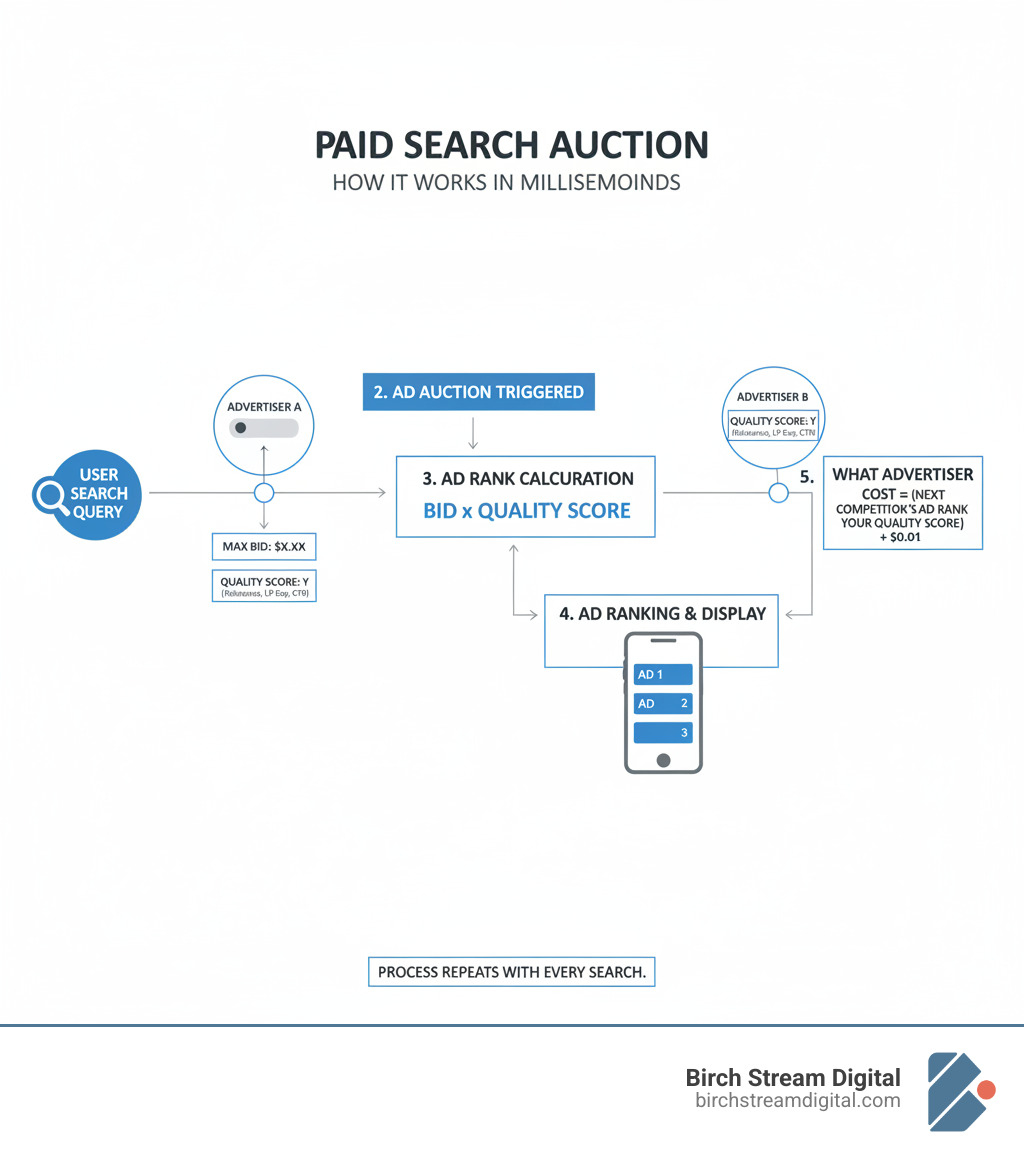
When someone in Winston-Salem searches for a service you offer, your ad doesn’t just magically appear. Behind the scenes, an auction happens in milliseconds. Your bid, combined with your ad quality, determines if your ad shows up and where it ranks on the page.
Analysis from Backlinko suggests that a large share of clicks go to the top few paid ads on the search results page. That makes smart bid management especially important for local businesses competing for visibility.
But here’s the truth: the highest bid doesn’t always win. Google rewards ads that are relevant and useful. A well managed bid strategy balances cost, quality, and timing to get you the best results for your budget.
In this guide, we’ll walk you through the types of bidding strategies available, how to choose the right one for your business, and what mistakes to avoid. Whether you’re new to paid search or looking to improve your campaigns, you’ll learn how to make bid management work for you.
The Two Paths of Bidding: Manual and Automated
When you’re getting started with paid search bid management, you face a fundamental choice. Do you want to control every detail yourself, or would you rather let the platform’s technology handle the heavy lifting?
Neither path is automatically right or wrong. What matters is picking the approach that fits your business, your budget, and where you want to go. For small businesses in the Triad, this decision shapes how much time you’ll spend managing campaigns and how quickly you’ll see results.
Manual bidding gives you complete control. You decide exactly what you’ll pay for each keyword. Automated bidding hands that work over to machine learning systems that adjust bids in real time. Both have their place, and understanding when to use each one makes all the difference.

The Hands-On Approach: Manual and Improved CPC
Manual CPC bidding means you set the maximum amount you’ll pay for each click on your keywords. Nothing changes unless you change it. You have full control over every bid.
This approach works well when you’re working with a small budget and need to watch every dollar. It’s also smart for new campaigns where you’re still gathering data and learning what works. You can test different bid amounts, see what happens, and adjust based on what you learn.
The downside? It takes time. You need to monitor your campaigns regularly and make adjustments as performance shifts. If you’re not checking in and optimizing, you’re likely leaving results on the table.
There used to be a middle ground called Improved CPC or eCPC. This let Google slightly adjust your manual bids up or down based on whether a click seemed likely to convert. It was a helpful bridge between full control and full automation. But Google phased it out for Search and Display campaigns. Any campaigns still using it were automatically switched to manual CPC. This change reflects where the industry is heading: toward smarter, more sophisticated automation.
Letting the Platform Help: An Introduction to Automated Bidding
Automated bidding is where machine learning takes over the work of adjusting your bids. Instead of you manually changing numbers a few times a week, the platform does it thousands of times a day. Every single time someone searches, the system calculates the optimal bid for that specific moment.
These systems use countless signals to make decisions in real time. They look at the user’s device type, their location, the time of day, their web browser, their language settings, and much more. For a business in Greensboro, this means your bid might be higher for someone searching on their phone during lunch than for someone browsing on a desktop at midnight.
In most accounts today, automated bidding plays a central role. Many advertisers rely on Google’s built-in bid strategies to handle the real-time adjustments that used to require manual work.
The appeal is simple: it can save time and, when there’s enough data, often improves performance. The algorithms can spot patterns and opportunities that would take a human hours to find, and they adjust bids instantly as conditions change throughout the day.
That doesn’t mean automated bidding is perfect or right for everyone. It works best when you have enough conversion data for the system to learn from. But when the conditions are right, it can be a powerful way to get better performance without spending your whole day managing campaigns.
Choosing Your Bidding Strategy
The right paid search bid management strategy isn’t something you pick at random. It flows directly from what you’re trying to accomplish. Are you looking to get more people to your website? Build brand awareness? Generate leads? Drive sales? Each goal calls for a different approach.
Paid search platforms like Google Ads offer several automated bidding strategies, each designed to help you hit specific targets. Some focus on clicks and visibility. Others focus on conversions and value. The trick is matching the strategy to what actually matters for your business.
Here’s a quick comparison of the main automated strategies:
| Strategy | Primary Goal | When to Use It |
|---|---|---|
| Maximize Clicks | Get as much traffic as possible | When you have a limited budget, low search volume keywords, or want to drive general website visits for brand awareness. |
| Target Impression Share | Maximize ad visibility | When you want your ads to appear at a specific location on the search results page (e.g., top of the page) for brand awareness or competitive presence. |
| Maximize Conversions | Get the most conversions within budget | When your main goal is to drive as many conversions (e.g., leads, sales) as possible within your set daily budget. |
| Target CPA (Cost Per Acquisition) | Achieve a specific cost per conversion | When you have a clear target for how much you’re willing to pay for each conversion and want Google to optimize bids to hit that average. |
| Maximize Conversion Value | Maximize total conversion value | When you have different conversion actions with varying values (e.g., high-value product sales vs. low value newsletter sign ups) and want to prioritize revenue. |
| Target ROAS (Return On Ad Spend) | Achieve a specific return on ad spend | For ecommerce businesses or campaigns where you want to ensure your ad spend generates a specific percentage of revenue back. |
Strategies Focused on Clicks and Visibility
Sometimes the goal is simple. You want more people to visit your website. You want your name out there. You want locals in Winston-Salem to know you exist.
Maximize Clicks does exactly what it sounds like. It gets you the most clicks possible within your budget. This works well when you’re just starting out, when you’re working with a tight budget, or when you’re targeting keywords that don’t get searched very often. It’s about building that initial traffic and getting your foot in the door.
Target Impression Share is all about being seen. This strategy helps your ads show up in a specific spot on the search results page. Maybe you want to be at the absolute top. Maybe you just want to be somewhere on the first page.
Picture this. A Winston-Salem bakery wants more website visits. They want to be visible when people search for “best bakery Winston-Salem.” With Target Impression Share, they can aim to always appear at the top of the page. That visibility matters. According to data from Backlinko, nearly half of clicks go to the top three paid ads on the search results page.
This strategy is perfect for brand awareness campaigns or when you’re competing in a crowded local market and need to stand out.
Strategies Focused on Conversions and Value
Getting clicks is one thing. Getting results is another. When your goal is to generate leads or make sales, you need strategies that focus on conversions and value.
Maximize Conversions is straightforward. You set your daily budget, and Google’s system works to get you as many conversions as possible within that budget. This is great for lead generation, especially when each lead has roughly the same value to your business.
Target CPA (Cost Per Acquisition) takes it a step further. You tell Google what you’re willing to pay for each conversion, and the system adjusts bids to hit that target on average. Let’s say a lead is worth $50 to your business in the Triad. You set a Target CPA of $50, and the platform bids accordingly. You’re putting a cap on what you’ll spend per result.
For businesses with varying product prices or different types of conversions, Maximize Conversion Value and Target ROAS (Return On Ad Spend) become powerful tools. Maximize Conversion Value aims for the highest total value from your conversions. If someone buys a $200 product versus a $20 product, the system prioritizes the higher value.
Target ROAS is about return. You tell the system how much revenue you want back for every dollar you spend. If you want $4 back for every $1 spent on ads, you set a Target ROAS of 400%. The platform then adjusts bids to hit that goal.
In the accounts we’ve managed, shifting to the right bid strategy has often led to meaningful lifts in conversions and overall conversion value. It’s not just about getting more clicks. It’s about aligning your bidding with profit and long-term business growth.
This is also where understanding how SEO and PPC can work together for better results becomes important. Both aim to attract valuable traffic. When they work in tandem, you cover more ground and reach more of the right people.
Best Practices for Your Paid Search Bid Management
Effective paid search bid management isn’t something you set up once and walk away from. It requires continuous improvement, careful testing, and smart data analysis. Think of it as tending a garden. You plant the seeds, but you need to water, prune, and adjust as things grow.
Our goal is always to optimize your campaigns to get the best return on your investment. That means regularly looking at what’s working, what’s not, and making adjustments based on real performance data. It’s this ongoing attention that separates campaigns that just spend money from campaigns that actually make money.
Why Quality Score is Your Secret Weapon
Even with automated bidding doing the heavy lifting, your Quality Score remains incredibly important. Think of it as a health check for your ads and keywords. Google uses Quality Score to measure how relevant and useful your ad is to the person searching.
The score is based on three main factors. First is ad relevance, which means how well your keyword matches your ad copy. Second is landing page experience, which looks at how relevant and user friendly your landing page is. Third is expected clickthrough rate (CTR), which predicts how likely your ad is to be clicked.
Here’s why this matters for your bottom line. High Quality Scores result in better ad positions and can even lead to lower CPCs. When your ads are more relevant, Google rewards you with lower click prices and better placement. It’s their way of encouraging advertisers to create useful, helpful ads instead of just throwing money at the problem.
While most experts don’t recommend bidding directly on Quality Score, we use its insights to improve your ad copy and landing pages. This boosts the overall health of your campaign. It’s truly your secret weapon for getting more results from the same budget.
Common Mistakes in Paid Search Bid Management
Even experienced advertisers can stumble. Avoiding these common pitfalls helps ensure your paid search efforts are effective and your budget isn’t wasted.
One of the biggest mistakes is adopting the wrong bidding strategy for your goal. If you want sales, don’t use a click focused strategy. If you want brand awareness, don’t optimize for conversions. Match your strategy to your objective, or you’ll be frustrated with the results.
Another common error is not setting bid caps with automated bidding. Automated bidding is smart, but it’s not foolproof. Always set a maximum bid cap to prevent overspending, especially when using strategies like Maximize Clicks. Without guardrails, costs can quickly spiral out of control.
Many businesses also make the mistake of using automation without enough historical data. Smart bidding strategies need data to learn from. If your campaign is brand new or has very few conversions, start with manual CPC first. Gather data for a few weeks before letting the algorithms take over. Otherwise, you’re asking the system to make decisions without enough information.
Don’t fall into the trap of ignoring other conversion factors either. Bids are just one piece of the puzzle. Landing page quality, ad relevance, and the overall user experience significantly impact conversions. We must account for these factors, or even perfect bidding won’t save a poorly designed campaign.
Perhaps the most expensive mistake is chasing the #1 spot at all costs. The top ad position isn’t always the most profitable. Sometimes, the second or third spot offers a better balance of cost and traffic quality. For a business in the Triad, it’s better to be in position two with a profitable cost per conversion than in position one and losing money on every click.
Here’s a simple truth: bidding more than a click is worth will erode your profits. If your product is worth $50 and you’re spending $50 or more per click, the math doesn’t work. We aim for the sweet spot where you get quality traffic at a cost that makes sense for your business, not just the top spot for bragging rights.
Measuring Success and Making Smart Choices
You can’t improve what you don’t measure. That’s why knowing if your paid search bid management efforts are working is so important. We rely on data driven decisions to see what’s effective and what needs adjusting. This keeps your advertising budget working hard for you, not against you.

How to Know if Your Bidding is Working
Looking at clicks alone won’t tell you much. We need to dig deeper into metrics that actually impact your bottom line.
Cost per conversion (CPA) tells us how much you’re paying to get a lead or make a sale. If you’re spending $50 to get a customer worth $100, that’s probably working. If you’re spending $150, we have a problem.
Return on Ad Spend (ROAS) is especially critical for ecommerce and revenue-driven campaigns. It shows how much revenue you generate for every dollar spent on ads. A 400% ROAS simply means you’re getting $4 back in revenue for every $1 you invest. It’s one of the cleanest ways to see whether your ad spend is pulling its weight.
Conversion rate reveals what percentage of people who click your ad actually do what you want them to do. Maybe they fill out a form, make a purchase, or call your business. A high conversion rate means your ads are attracting the right people and your landing pages are doing their job.
Clickthrough rate (CTR) shows how often people click when they see your ad. A strong CTR signals that your ad is relevant and compelling to searchers.
But here’s what really matters: profit. We want to know how your ad spend translates into actual money in your pocket. A simple way to think about PPC ROI is:
(Revenue – Ad Cost) ÷ Ad Cost
Looking at ROAS and ROI together helps us keep your campaigns focused on what you actually care about: growing the business, not just winning impressions..
By watching these metrics closely, we can spot opportunities to improve. Our goal is always higher conversion rates, better ROI, and far less wasted ad spend.
When to Use Tools vs. Get Local Help
There’s no shortage of PPC bid management tools out there. These platforms can automate bid adjustments, provide insights across multiple channels, and help optimize your budget. They absolutely have their place and can save time.
Many of these tools promise to save time and improve performance, and in the right hands they can. The catch is that choosing the right tool, and using it well, still takes expertise. A platform can tell you what happened, but it rarely explains why or what to do next. That’s where a clear strategy and experienced eyes matter.
For businesses in the Triad region, we offer something different. We bring local knowledge and a personalized approach. We don’t just run your campaigns. We help you understand what the numbers mean, set goals that make sense for your business, and adjust strategies as you grow.
Tools are fantastic for efficiency. But strategy, experience, and clear communication matter just as much. We’ve found that businesses often struggle not because they lack technology, but because they need someone to interpret the data and guide decisions.
When does it make sense to get local help? If you’re short on time or don’t have in house expertise, paid search bid management can feel overwhelming. If you need someone to make sense of the data and develop a real strategy, that’s where we come in. And if you want to maximize your ROI, our experience managing campaigns for businesses like yours can make a real difference.
Working with a PPC Management Firm means you get dedicated support from people who understand the local market and your specific needs. We’re here to help you make smart choices, not just run ads.
Let’s Make Your Paid Ads Work for You
Paid search bid management isn’t something you figure out once and then forget about. It’s a process. And like most things worth doing, it gets better with practice, testing, and a willingness to learn what works for your specific business.
If you’re just getting started, that’s okay. Start simple. Manual bidding can teach you a lot about your keywords and audience, especially when you’re still gathering data. Once you have enough information, you can explore automated strategies that align with your goals.
Your bidding strategy should match what you actually want to achieve. If you need leads, focus on conversions. If you want visibility, optimize for impressions. Don’t chase the top ad spot just because it’s there. The most expensive position isn’t always the most profitable one.
Your Quality Score matters more than you might think. It’s essentially a health check for your campaigns. Better ad relevance, a strong landing page, and a good expected clickthrough rate all work together to lower your costs and improve your ad placement. We use Quality Score insights to make smart improvements that benefit your bottom line.
Keep an eye on the metrics that truly matter. Cost per conversion, return on ad spend, conversion rate, and clickthrough rate all tell you different parts of the story. Together, they show you whether your campaigns are delivering real value or just spending money.
Most importantly, it’s okay to ask for help. Managing paid search takes time, expertise, and constant attention. That’s what we do at Birch Stream Digital. We’re not here to overwhelm you with jargon or push services you don’t need. We’re here to be your partner, helping businesses in Winston-Salem, Greensboro, and throughout the Triad region get real, measurable results from their advertising.
We believe in clarity. We believe in doing work that actually moves the needle. And we believe that every dollar you spend on ads should be working as hard as you do.
Let’s talk about your goals and figure out how to make your paid search campaigns work better for you.